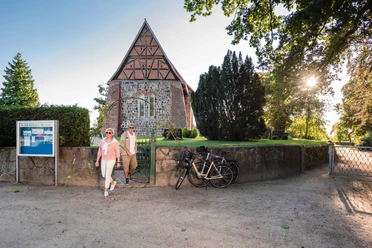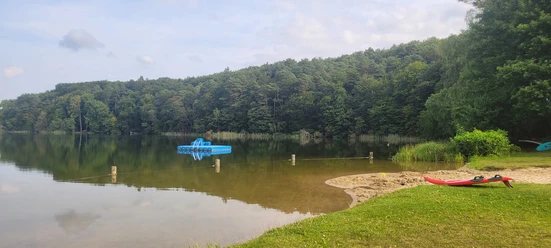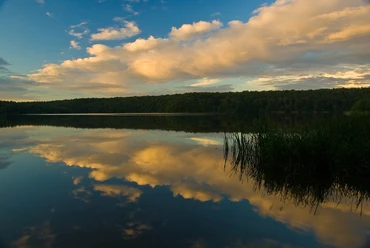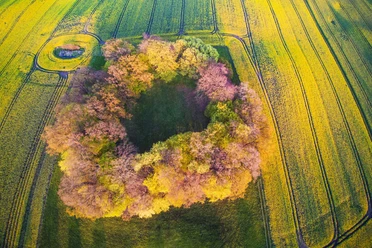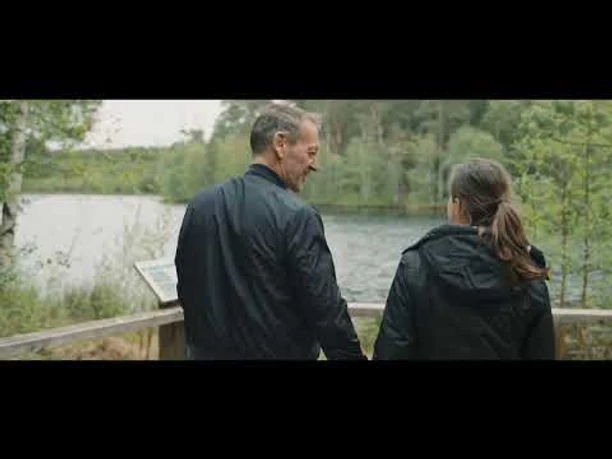


Here, too, the Ice Age was the architect: the Hellbach Valley, with its wet meadows and orchid fields, is a tunnel valley washed out by meltwater, through which the Hellbach stream flows, giving the valley its name. The three completely different lakes are noteworthy. The nutrient-poor turquoise-blue Krebssee has a visibility depth of up to 7 metres. Schwarzsee is a brown water lake with rare peat mosses, sedges and marsh calla lilies in its peripheral areas. Lottsee, on the other hand, is rich in nutrients and provides a home for endangered plant species in its silted-up areas.
Hiking trails: various lengths, signposted
Hiking car park: between Lehmrade and Drüsensee
Viewpoint: platform at Schwarzsee
Delightful diversity
The Hellbach Valley is home to a wealth of precious habitats. Framed by wooded valley slopes, the lively, meandering Hellbach stream is lined with species-rich wet meadows featuring specialist plants such as broad-leaved marsh orchids and adder's tongue, large sedge marshes, reed beds and swamp forests.
In the middle of it all, three lakes shimmer in different colours. The silting, algae-rich Lottsee glows greenish, the clear, lime-rich Krebssee is turquoise blue and the boggy Schwarzsee with its deceptive floating mats appears dark brown. Lottsee is adorned with yellow water lilies, and at Schwarzsee, the white finger-shaped inflorescence of the marsh calla glows in rich green. If you are lucky, you may spot the colourful kingfisher perched on one of the three bridges in Hellbachtal.
Ice and water shaped the land
Under a glacier tongue, the Tunneltal valley was carved 20 to 30 metres deep into the landscape. Later, the meltwater flowed away only slowly, leaving behind a marshy lowland. Broken-off and covered chunks of dead ice and falling meltwater created various lakes. It was not until the 1960s/70s that the wet lowlands were drained and the stream straightened. However, the Hellbach has been flowing freely again since 1987.
Well connected by cycle paths and hiking trails
The hiking car parks at the north and south ends of Lake Drüsensee can be reached via the Mölln road towards Lehmrade. There is another hiking car park in Gudow. When hiking, Adam and Eve – two intertwined oak trees west of Krebsee lake at Hellbach bridge – are on the way. The signposted hiking trails lead hikers from Mölln to Sarnekower See lake along the wet meadow valley and its three lakes. The district-wide church cycle tour and the Möllner Radweg 2 cycle path cross the Hellbach valley at Adam and Eve.
Hiking trails
Schmalsee – Lütauer See – Drüsensee – Hellbachtal – Gudower Mühle – Wasserkrug (approx. 14 km)
Schmalsee – Lütauer See – Drüsensee – Hellbachtal – Wasserkrug (approx. 11 km)
European long-distance hiking trails 1, 6 and 9
Circular cycle tours along the way
Church tour (approx. 49 km)
Mölln – Seedorf – Groß Zecher – Gudow – Mölln
Mölln Tour 2 (approx. 32 km)
Mölln – Gudow – Güster – Mölln
Hiking trails: various lengths, signposted
Hiking car park: between Lehmrade and Drüsensee
Viewpoint: platform at Schwarzsee
Delightful diversity
The Hellbach Valley is home to a wealth of precious habitats. Framed by wooded valley slopes, the lively, meandering Hellbach stream is lined with species-rich wet meadows featuring specialist plants such as broad-leaved marsh orchids and adder's tongue, large sedge marshes, reed beds and swamp forests.
In the middle of it all, three lakes shimmer in different colours. The silting, algae-rich Lottsee glows greenish, the clear, lime-rich Krebssee is turquoise blue and the boggy Schwarzsee with its deceptive floating mats appears dark brown. Lottsee is adorned with yellow water lilies, and at Schwarzsee, the white finger-shaped inflorescence of the marsh calla glows in rich green. If you are lucky, you may spot the colourful kingfisher perched on one of the three bridges in Hellbachtal.
Ice and water shaped the land
Under a glacier tongue, the Tunneltal valley was carved 20 to 30 metres deep into the landscape. Later, the meltwater flowed away only slowly, leaving behind a marshy lowland. Broken-off and covered chunks of dead ice and falling meltwater created various lakes. It was not until the 1960s/70s that the wet lowlands were drained and the stream straightened. However, the Hellbach has been flowing freely again since 1987.
Well connected by cycle paths and hiking trails
The hiking car parks at the north and south ends of Lake Drüsensee can be reached via the Mölln road towards Lehmrade. There is another hiking car park in Gudow. When hiking, Adam and Eve – two intertwined oak trees west of Krebsee lake at Hellbach bridge – are on the way. The signposted hiking trails lead hikers from Mölln to Sarnekower See lake along the wet meadow valley and its three lakes. The district-wide church cycle tour and the Möllner Radweg 2 cycle path cross the Hellbach valley at Adam and Eve.
Hiking trails
Schmalsee – Lütauer See – Drüsensee – Hellbachtal – Gudower Mühle – Wasserkrug (approx. 14 km)
Schmalsee – Lütauer See – Drüsensee – Hellbachtal – Wasserkrug (approx. 11 km)
European long-distance hiking trails 1, 6 and 9
Circular cycle tours along the way
Church tour (approx. 49 km)
Mölln – Seedorf – Groß Zecher – Gudow – Mölln
Mölln Tour 2 (approx. 32 km)
Mölln – Gudow – Güster – Mölln
Directions & Parking facilities
- Anfahrt ÖPNV: Bus 8514 bis „Drüsen“, alternativ diverse Buslinien bis „Mölln, ZOB“, RE83 bis Bahnhof „Mölln“
Parken: Parkplatz "Tiefe Kuhlen" zwischen Drüsen und Lehmrade Author
Organization
Herzogtum Lauenburg Marketing und Service GmbH